Best Photo Spots in Rome: A Hop On Hop Off Photography Guide
Summary
Street-level Rome is beautiful. But it is also crowded, cluttered with parked scooters, and full of other tourists standing exactly where you want to stand. The open-top deck of a bus sightseeing Rome circuit gives you something that no amount of patience on the ground can replicate: elevation, movement, and a continuously changing perspective on a city that was built to be seen from above as much as from within. Whether you are shooting with a professional camera, a mirrorless, or a phone, the upper deck of a big bus tours or city sightseeing Roma bus is effectively a slow-moving tripod that delivers a completely different angle on the Colosseum, the Vatican dome, and the Forum than anything accessible at street level. This guide tells you exactly where to sit, when to ride, and which stops to prioritise for the shots that actually look like Rome.
Why the Bus Is a Photographer's Best Tool in Rome
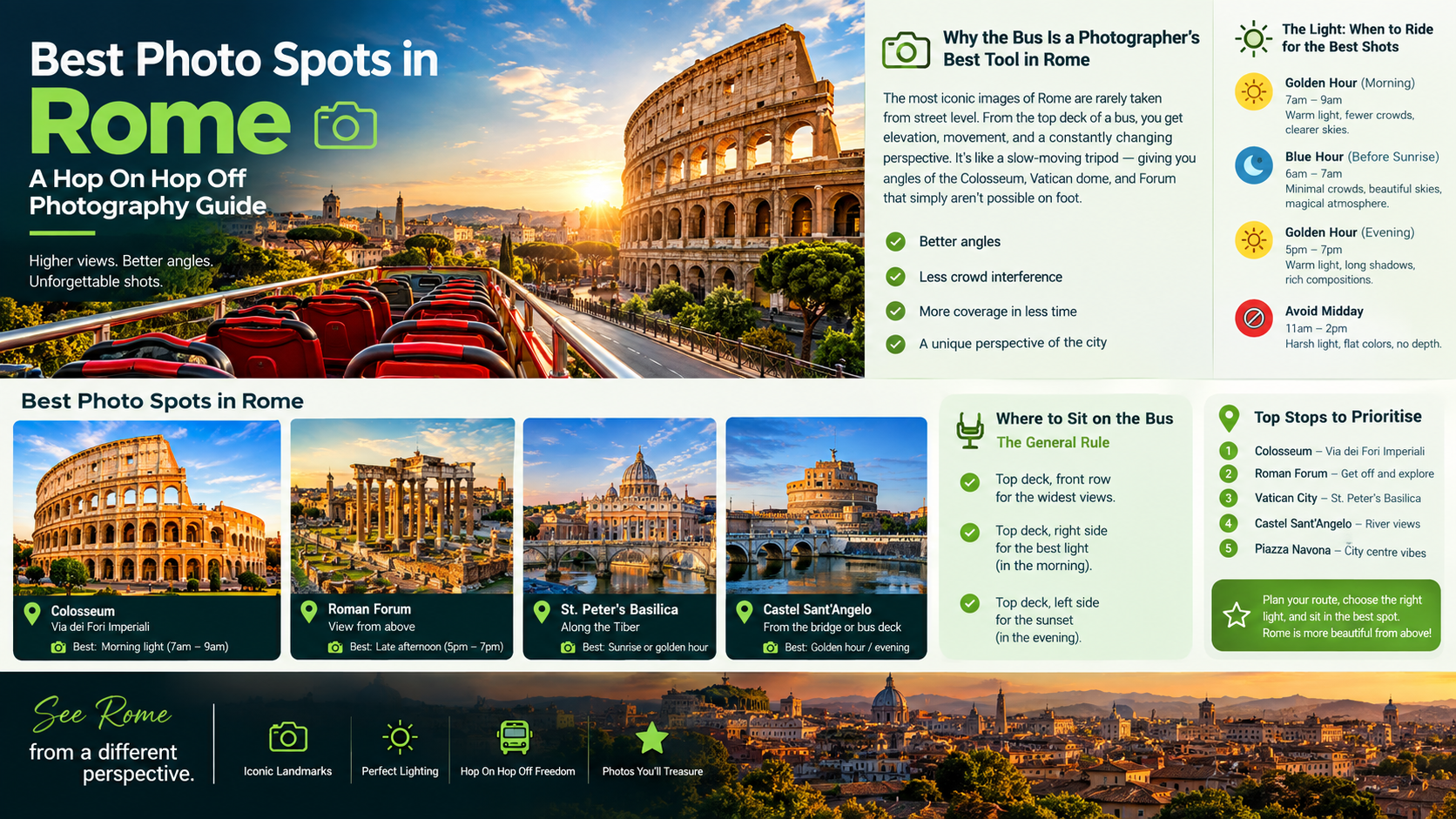
Every serious Rome photographer eventually discovers the same thing: the most iconic images of this city are rarely taken from street level. The Colosseum at eye level gives you a section of wall and a lot of other tourists. From the top deck of a bus sightseeing Rome circuit approaching along Via dei Fori Imperiali, you get the full structure rising above the road with the ancient pavement receding in the foreground and the curve of the arched arcades visible from an angle that the street simply does not offer.
The same principle applies across the city. The Forum from above reveals the spatial logic of the ancient complex in a way that walking through it does not. The approach to St. Peter's along the river shows you the dome clearing the surrounding roofline progressively as you get closer, creating a sequence of compositions that changes with every fifty metres of movement. Castel Sant'Angelo reflected in the Tiber is a photograph that requires the elevated perspective of a bridge or a bus deck to frame properly.
The city tour Rome hop on hop off network covers every one of these compositions in a single circuit. You just need to know where to sit, when to be there, and which direction to point the camera.
The Light: When to Ride for the Best Shots
Before anything else about positioning or framing, light is the variable that determines whether a Rome photograph works or does not. The city's ancient stone is predominantly warm in tone, travertine and tufa and marble that respond very differently to morning light, midday sun, and golden hour than they do to the flat white light of peak afternoon.
The Golden Hour: 7am to 9am
The first two hours of morning light in Rome are extraordinary for photography. The sun is low in the east, which means everything facing east catches direct warm light while the western-facing surfaces are in soft shadow. From the top deck of a bus sightseeing Rome morning circuit, the approach to the Colosseum from the west during this window gives you the monument's eastern facade in full direct morning light against a sky that has not yet bleached to white.
This is also the time before most tour groups have assembled, before the coach parties arrive, and before the general tourist volume reaches its midday peak. The big bus tours circuits typically begin their first departures around 9am, which means boarding for the first service and riding through the morning light gives you the cleanest backgrounds and the best sky conditions of any time of day.
The Blue Hour: Just Before Sunrise
For photographers specifically targeting minimal crowds and extraordinary sky conditions, the period between 6am and 7am in Rome during spring and summer offers something genuinely special. The monuments are not yet lit by direct sun, the sky is a deep graduated blue, and the city is as close to empty as it gets. Some bus tours Rome Italy operators run early departures during peak season to serve this window. Check sightseeingroma.com for first departure times on your specific travel dates.
The Golden Hour: 5pm to 7pm
Afternoon golden hour in Rome, particularly during spring and autumn when the sun sets at a useful angle rather than the steep summer trajectory, delivers warm directional light across the western and southern faces of the major monuments. From the top deck of a city sightseeing Roma afternoon circuit, the Forum complex caught in late afternoon light with the Palatine Hill casting long shadows across the ruins below is one of the most photographically rich compositions in the entire city.
What to Avoid: 11am to 2pm
The midday window produces flat, harsh overhead light that strips depth from stone surfaces and bleaches the sky. The shadows are short and fall directly below the structures rather than adding compositional interest. This is the period to use for indoor attractions: the Vatican Museums, the Colosseum interior if your entry is timed for this window, or a long lunch. Save the bus deck for the morning and afternoon light.
Where to Sit on the Bus for the Best Shots
The General Rule
The upper open-top deck of both the big bus tours double-decker and the city sightseeing Roma bus is always the right choice for photography. The elevated perspective removes street clutter, parked vehicles, and ground-level tourists from your foreground. It also puts you at a height that more closely matches the intended viewing angle for Rome's major monuments, many of which were designed to be seen from an elevated perspective.
On the upper deck, the front row of seats gives you unobstructed forward-facing views and the widest angle on what is ahead of the bus. For video as well as stills, the front row catches the movement of the journey most dynamically. The trade-off is that you are fully exposed to wind, which at bus speed creates camera shake on longer focal lengths.
The second or third row on either side is the compromise position that most experienced bus photographers prefer. You have sightlines above the front railing, reduced wind exposure, and the option to shoot in either direction as the bus moves.
Left Side vs Right Side
The correct answer to which side of the bus to sit on depends entirely on which direction the bus is currently travelling and which monuments are approaching on which side of the road. However, there are some consistent principles.
On the outbound journey from Termini toward the Colosseum, the Colosseum and the Forum complex are on the right side of the bus as you travel south along Via dei Fori Imperiali. The left side of the bus gives you the Imperial Forums in the opposite direction.
On the approach to Castel Sant'Angelo along the Lungotevere, the fortress and the river reflection are on the right side of the bus heading north.
On the approach to St. Peter's Square, the basilica dome appears straight ahead and then shifts slightly left as the bus rounds the final approach corner.
The practical advice is to start a circuit once as a scouting pass before you begin serious shooting. Ride the full loop without committing to a shooting position and identify which side of the bus each key composition falls on. Then on the second circuit, position yourself correctly for each shot.
The Key Compositions: Stop by Stop
Approaching the Colosseum on Via dei Fori Imperiali
This is the defining composition of Rome bus sightseeing photography. The wide avenue that Mussolini cut through the ancient Forum area in the 1930s, controversial as it is historically, creates a perfectly proportioned approach corridor with the Colosseum centred at the vanishing point. From the top deck of the bus, this approach shot with the road receding ahead, the ancient Forum ruins on the left, and the Colosseum growing in the frame as the bus advances is one of the most recognisably Roman images possible to capture.
Best camera position: Front row centre, wide lens, ride it through from around 200 metres back.
The Forum From the Palatine Hill Stop
If you time your Colosseum visit to include the Palatine Hill, the view of the Forum from the hilltop terrace is not technically from the bus but it is the elevated perspective that the bus introduced you to. From Palatine, the full spatial logic of the ancient Forum complex becomes visible: the sequence of temples, the Sacred Way, the Arch of Titus at the far end, and the Colosseum beyond it in a single frame.
Castel Sant'Angelo and the Tiber Reflection
The city sightseeing roma and big bus tours routes both pass along the Lungotevere at a point where Castel Sant'Angelo is visible across the water with its reflection extending into the Tiber below. At golden hour this composition is extraordinary. The warm light catches the cylindrical fortress, the angel statues on the bridge in the foreground create depth, and the water surface provides a mirrored element that softens the otherwise solid geometry of the scene.
Best camera position: Right side of the upper deck, medium telephoto, focus on the bridge angels with the fortress behind.
The Approach to St. Peter's Along the River
The progressive reveal of St. Peter's dome as the bus moves north along the Tiber is a sequence rather than a single composition. At the far end of the river approach, the dome is visible above the roofline of the riverside buildings. As the bus advances, it clears the surrounding structures progressively and rises in the frame. The full reveal at the Via della Conciliazione end, with the basilica dome centred above the avenue, is the definitive St. Peter's shot from a moving perspective.
The Forum in Golden Hour
The afternoon sightseeing Rome circuit catches the Forum in the most photographically flattering light of the day. The western sun angles across the surviving columns and temple fragments at around 30 degrees during autumn and spring, creating long shadows that add depth and drama to what midday light reduces to a flat archaeological field.
Best camera position: Left side of the bus on the return journey from the Vatican toward the Colosseum, around 200mm to isolate individual temple structures from the surrounding site.
Gear Advice for Bus Photography
Image stabilisation is essential. A moving bus generates constant low-frequency vibration that shows up in images shot at slower shutter speeds without stabilisation. If you are shooting on a mirrorless or DSLR, use the in-body image stabilisation setting. If you are shooting on a phone, the default computational stabilisation handles this adequately for most focal lengths.
Use faster shutter speeds than you think you need. At bus speed, even a technically correct handheld shutter speed for a stationary subject will introduce blur from vehicle movement. As a starting point, use at least 1/500 second for wide shots and 1/1000 second or faster for telephoto focal lengths.
A polarising filter changes the sky significantly. Roman summer skies are often a slightly hazy blue rather than deep saturated blue. A circular polarising filter on a wide lens or zoom suppresses the haze, deepens the sky, and reduces glare on the travertine surfaces of the monuments. Worth carrying if you have one.
Shoot RAW if your camera allows it. The warm morning and golden hour light in Rome responds beautifully to subtle white balance adjustments in post-processing that JPEG captures do not allow. RAW files give you full latitude to bring out the quality of the light without introducing colour noise.
FAQ
Which Side of the Big Bus Tours Deck Is Best for Photos?
There is no single correct answer because the best side changes depending on which direction the bus is travelling and which landmarks you are approaching. As a practical guide: on the outbound journey from Termini toward the Colosseum along Via dei Fori Imperiali, the Colosseum approaches on the right side and the Imperial Forum ruins are on the left. On the approach to Castel Sant'Angelo along the Lungotevere heading northwest, the fortress and river are on the right. The most useful approach is to ride a full circuit as a scouting pass first, noting which side each key composition falls on, and then position yourself accordingly on the second circuit. Front-row seats on either side give you the widest forward view. Second or third row on the relevant side gives you better stability and the option to brace against the seat back when using longer focal lengths.
Can I Take Professional Photos from the City Sightseeing Roma Bus?
Yes. City sightseeing Roma does not have a policy against professional photography equipment on the open-top deck. Photographers with mirrorless cameras, DSLRs, and even moderate telephoto lenses regularly use the bus for professional and commercial shooting. The practical constraints are wind at bus speed, which creates shake on longer focal lengths, and the need for faster shutter speeds than you would use for stationary subjects. There is no requirement to declare professional equipment at boarding, no additional fee for carrying camera gear, and no restriction on publishing or selling images taken from the bus. If you are planning a dedicated photography circuit rather than a sightseeing day, boarding the first departure of the morning, riding the full loop once to scout compositions, and then positioning yourself strategically for a second circuit gives you the most productive approach to the route.
Is Morning or Golden Hour Better for Sightseeing Rome Photography?
Both are excellent and they produce genuinely different results, so the honest answer is that the best approach is to use both if your schedule allows. Morning golden hour, roughly 7am to 9am, gives you east-facing monuments in direct warm light with quieter streets and fewer competing tourists in the frame. The Colosseum approach from the west in morning light is one of the strongest compositions available on the entire bus sightseeing Rome route. Afternoon golden hour, roughly 5pm to 7pm depending on the season, gives you west and south-facing surfaces in warm directional light with long shadows that add depth and visual interest to the ancient stone. The Forum in afternoon light is significantly more dramatic than the same view at midday. If you can manage only one period, morning light is marginally preferable because the streets are emptier and the sky is typically clearer before the heat haze of the day builds. But afternoon golden hour on a bus tours Rome Italy circuit, particularly in spring and autumn when the sun sets at a useful angle, produces images that morning cannot replicate.
The Best Camera in Rome Is the One in the Right Place at the Right Time
Equipment matters less than position and light in Rome photography. The difference between a good Rome photograph and a great one is almost never the camera. It is whether you were on the top deck of a bus sightseeing Rome circuit as the morning light hit the Colosseum along Via dei Fori Imperiali rather than standing on the pavement below looking up at the same monument with fifty other tourists obscuring the foreground.
The big bus tours and city sightseeing Roma open-top deck gives you the position. The golden hour gives you the light. The only remaining variable is when you book your seat.
Book your sightseeing Rome bus pass through sightseeingroma.com. Choose the earliest available morning departure. Climb to the top deck. Sit on the right side for the first outbound stretch. And let Rome arrange itself in front of your lens.
Comments (0)
At Sightseeing Roma, we believe that every traveler deserves to explore the majestic beauty and rich history of Rome with ease and comfort. Established with a passion for delivering unforgettable experiences, we are your gateway to the heart of this ancient city.
Bus Services & Tours
Stay Updated
Sign up to receive exclusive offers, travel tips, and the latest bus routes directly to your inbox.
©2026 All Rights Reserved to Sightseeing Roma