Walking with Emperors: An Ancient Rome Trail Map by Bus
Summary
The archaeological heart of Rome is not a single site. It is a continuous zone stretching south and east from Piazza Venezia through the Colosseum and Forum complex, across the Palatine and Caelian hills, down to the Circus Maximus and the Baths of Caracalla. Within this zone, eight centuries of Roman imperial construction are layered on top of each other in a density that rewards a full day of dedicated exploration rather than a two-hour monument visit. Bus tours in Rome Italy connect the major entry points of this zone from a single circuit, and this guide maps the full imperial trail, from the Colosseum's upper tiers to the Baths of Caracalla, for the visitor who came to Rome specifically for the ancient city rather than the Renaissance and baroque overlay.
Why the Archaeological Heart of Rome Requires a Strategy, Not Just a Map
Most visitors to Rome approach the Colosseum as a standalone destination: arrive, queue, enter, exit, move on. This is understandable given the monument's global recognition and its position at the front of every Rome itinerary. But the Colosseum is one piece of a much larger archaeological landscape that, approached with context and sequence, delivers something far more powerful than a single impressive building.
The imperial zone of Rome, the area bounded roughly by the Capitoline Hill to the northwest, the Circus Maximus to the south, and the Celian Hill to the east, contains:
The Colosseum, the most recognisable surviving Roman structure
The Roman Forum, the political and religious centre of the ancient city
The Palatine Hill, where Rome's emperors built their palaces above the city they ruled
The Imperial Fora of Caesar, Augustus, Nerva, and Trajan, the successive expansions of the civic centre across four centuries
The Circus Maximus, the ancient world's largest entertainment venue
The Baths of Caracalla, the most preserved large-scale bathing complex in Rome
All of these are accessible from the city bus tours rome italy circuit, and all of them reward more time and more attention than the standard monument-ticking tourist day allows.
Understanding the Imperial Zone: What the Colosseum Area Actually Contains
The single most useful reframe for a historically engaged visitor to the Colosseum area is to understand that the Colosseum, the Forum, and the Palatine Hill are a single archaeological complex, accessed on a combined ticket, and that separating them into individual time-pressured visits is the most common way to miss the full picture.
The standard combined ticket covers entry to the Colosseum, the Roman Forum, and the Palatine Hill. These three sites tell a sequential story: the entertainment culture of Roman society (Colosseum), the civic and religious life of the republic and early empire (Forum), and the domestic world of the emperors who presided over both (Palatine). Moving through them in sequence, spending genuine time at each, produces a comprehension of ancient Roman life that no individual site visit achieves.
Allow a minimum of three hours for this combined visit. Four hours is better for a history enthusiast. The sites are adjacent and connected by walking paths, so no additional transport is needed between them within the complex.
The Colosseum: What You Are Actually Looking At
The Flavian Amphitheatre, universally known as the Colosseum, was completed in 80 AD under the Emperor Titus. It was the largest amphitheatre in the Roman world, with a seating capacity estimated between 50,000 and 80,000, and it operated continuously for approximately four centuries.
Several things are worth understanding before you enter, because they transform what the building looks like once you are inside.
The missing exterior. The Colosseum currently has approximately two-thirds of its original exterior standing. The western and southern sections retain substantial original fabric. The north and east sections, seen in the famous partially ruined photographs, were stripped over centuries for building material by medieval and Renaissance Rome. What you see is a ruin but a structurally stable and archaeologically interpreted ruin, not a decayed fragment.
The missing floor. The wooden arena floor that covered the hypogeum, the underground service complex beneath the arena, was removed in the nineteenth century to expose the underground structure. Visitors with standard access see the hypogeum from above; those with premium tickets can enter the underground spaces and the arena floor level where reconstructed flooring allows. If seeing the Colosseum from the arena floor level is a priority, the specific ticket type matters.
The seating system. The tiered seating arrangement of the Colosseum reflected Roman social hierarchy precisely: the senatorial tier at the lowest level closest to the action, the equestrian class above, the general population in the upper tiers, women and slaves at the very top in wooden seating sections that have not survived. The remaining concrete tiers give a clear picture of the structural approach; the social meaning requires the interpretation.
The approach from Via dei Fori Imperiali. The view of the Colosseum from bus sightseeing rome vehicles approaching along Via dei Fori Imperiali, the broad avenue that Mussolini cut through the Forum zone in the 1930s, gives you the full western facade from the elevated perspective of the upper bus deck. This view, with the Colosseum centred at the end of the avenue with the Forum ruins on both sides, is the canonical image of the site and it is best experienced from the bus before you alight, rather than being the view you eventually find when you walk around the corner.
The Roman Forum: Reading the Site Like a Historian
The Roman Forum is the most information-dense site in Rome and the one that most rewards prior reading. Without context, it reads as a field of fragmentary columns and walls. With context, it is one of the most intensively occupied and historically significant pieces of ground in Western civilisation.
The Forum was the centre of Roman public life for roughly a thousand years: the site of elections, legal proceedings, religious ceremonies, triumphal processions, and public speeches. The Via Sacra, the Sacred Way, ran through its length as the route of triumphal processions returning from military victories. The temples that lined it served the official state religion of the Roman world. The basilicas beside it were not churches but law courts and commercial exchange buildings.
Key structures to identify and understand:
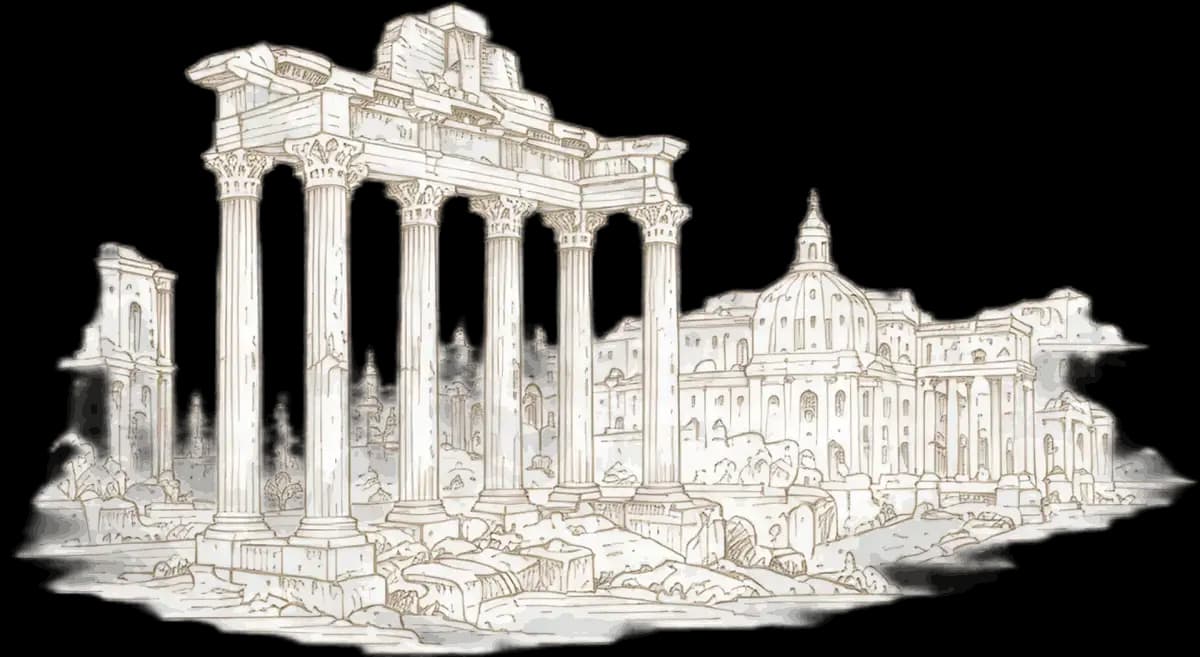
The Temple of Saturn (496 BC, rebuilt 42 BC): The eight remaining columns of the Temple of Saturn at the western end of the Forum are the oldest standing structure in the complex. The building housed the state treasury in antiquity.
The Arch of Septimius Severus (203 AD): The triumphal arch at the northwestern corner of the Forum, celebrating the emperor's victories in the Parthian campaigns, is the best-preserved of the Forum's surviving arches and the most architecturally complete.
The Temple of Vesta: The circular temple and associated House of the Vestal Virgins occupied the southeastern corner of the Forum. The sacred flame of Vesta was maintained here continuously for approximately a thousand years.
The Arch of Titus (81 AD): At the southeastern end of the Via Sacra, the Arch of Titus celebrates Titus's destruction of Jerusalem in 70 AD. The reliefs on the inner face of the arch include the oldest surviving depiction of the Menorah from the Temple of Jerusalem.
From the hop on and off tour rome Colosseum stop, the Forum is accessed directly via the Via Sacra entrance on the south side of the archaeological park.
The Palatine Hill: Above the Forum, Above the City
The Palatine Hill rises immediately south of the Roman Forum and is the site of Rome's earliest continuous occupation, the legendary location of Romulus and Remus and the actual location of Iron Age settlement from at least the 10th century BC, and the place where the emperors of the Julio-Claudian and later dynasties built their palaces.
The name Palatine is the etymological root of the English word "palace," via the Latin palatium, which originally referred to this specific hill before becoming a generic term for a royal residence.
The practical benefit of climbing the Palatine for the sightseeing rome visitor is the view. From the terrace above the Forum, the entire archaeological complex is visible below: the Forum's column fragments, the Arch of Septimius Severus, the Temple of Saturn, the Colosseum beyond the eastern end of the Forum. This is the elevated perspective that gives the entire site spatial coherence, and it is included in your combined Colosseum ticket.
The Palatine also contains substantial palace ruins, particularly the Domus Augustana and the Domus Flavia, the palace complex developed under Domitian in the late first century AD and used by subsequent emperors for centuries. The scale of the ruins makes the scope of imperial private life comprehensible in a way that no other site in Rome quite achieves.
The Imperial Fora: The Other Forum Complex Most Visitors Walk Past
Via dei Fori Imperiali, which the bus sightseeing rome circuit travels along between Piazza Venezia and the Colosseum, was built directly over the Imperial Fora, the sequence of public squares built by Julius Caesar, Augustus, Vespasian, Nerva, and Trajan as expansions of the original Roman Forum.
These fora are visible from the bus on both sides of Via dei Fori Imperiali and are accessible via viewpoints along the road. The Forum of Trajan, the largest and most ambitious of the Imperial Fora, includes Trajan's Column, a 38-metre spiral narrative column covered in relief carvings depicting the Dacian Wars, and the Trajan's Markets complex, a multi-storey curved commercial building that is one of the best-preserved Roman market complexes in the world.
Most city bus tours rome italy visitors ride past these sites rather than stopping at them. The history enthusiast should alight specifically at the Fori Imperiali stop or walk from Piazza Venezia to engage with these sites at ground level rather than from the bus deck.
The Circus Maximus: Scale and Imagination
The Circus Maximus, the ancient chariot racing circuit in the valley between the Palatine and Aventine hills, is today a long flat green space that gives little immediate visual impression of what it once was. The stands have been completely removed, the track surface is grass, and the overall effect requires significant imaginative reconstruction.
But the scale, once you understand what the numbers mean, is extraordinary. The track was approximately 600 metres long and 150 metres wide. The total seating capacity in its final form was estimated at up to 250,000 spectators, making it the largest public entertainment venue in the ancient world by capacity. The sound of a full crowd at the Circus Maximus would have been audible across most of Rome.
The hop on hop off roma Circus Maximus stop is the main access point for this site, which is free to enter and walk through. The view from the eastern end of the site, looking down the full length of the track with the Palatine Hill immediately above on the left and the Aventine on the right, gives the best sense of the site's original scale.
The Baths of Caracalla: The Most Underestimated Site in Rome
The Baths of Caracalla, completed in 216 AD under Emperor Caracalla, are accessible from the Circus Maximus bus sightseeing rome stop by a fifteen-minute walk southeast. They are one of the least-visited major ancient sites in Rome given their scale and preservation, and the history enthusiast who makes the detour will find an experience that is in some ways more powerful than the Colosseum precisely because the crowds are smaller.
The complex covered approximately 25 hectares, with bathing halls, exercise yards, libraries, garden areas, and underground service tunnels extending below the main structure. The surviving walls in the main bathing hall section rise to their original height in several areas, giving a visceral sense of the interior volumes that the collapsed state of most ancient Roman buildings rarely allows.
The opus sectile marble floor fragments and the mosaic pavements visible in several rooms are extraordinary. The underground tunnels, accessible on certain ticket types, contain the service infrastructure of the complex: the tunnels for heating, water supply, and slave movement that made the public baths function at scale.
How Bus Tours in Rome Italy Connect the Imperial Zone
The bus tours in rome italy circuit approaches the imperial zone from two directions. The primary approach via Via dei Fori Imperiali from Piazza Venezia delivers passengers along the Imperial Fora with views to both sides before arriving at the Colosseum. The secondary approach via the Circus Maximus stop, which some routes include, gives access to the southern part of the zone.
For a full imperial zone day, the sequence is:
Board at Termini. Ride to the Colosseum stop via Via dei Fori Imperiali, viewing the Imperial Fora from the bus on the outbound journey. Alight at the Colosseum. Spend three to four hours at the Colosseum, Forum, and Palatine Hill complex on your pre-booked combined entry. Reboard at the Colosseum stop. Ride one stop to the Circus Maximus. Walk to Circus Maximus for the site orientation. Continue walking fifteen minutes to the Baths of Caracalla for the afternoon session. Return via taxi or local bus to the nearest hop on hop off roma stop for the return to Termini.
The Ideal Ancient Rome Day: Hourly Structure
8:30am Board the first city bus tours rome italy departure at Termini. Take the upper deck for the Via dei Fori Imperiali approach to the Colosseum.
9:00am Pre-booked timed entry to the Colosseum. Spend ninety minutes inside, covering the arena level, the tiered gallery, and the exhibition areas.
10:30am Exit via the Forum entrance included in your combined ticket. Walk the Via Sacra from west to east, identifying the major temple remains and the Arch of Titus at the far end. One hour.
11:30am Climb to the Palatine Hill via the internal path. Spend forty-five minutes at the palace ruins and the terrace viewpoint above the Forum.
12:15pm Exit the archaeological park via the Palatine exit. Walk or take a short taxi to the Circus Maximus stop. Fifteen minutes at the site for orientation and photography.
1:00pm Walk fifteen minutes southeast to the Baths of Caracalla. Spend ninety minutes inside, including the main bathing hall ruins and any accessible underground areas.
2:30pm Exit the Baths. Taxi or local bus back to the Circus Maximus bus sightseeing rome stop. Reboard for the return to Termini or continuation to afternoon stops.
FAQ
Which City Bus Tours Rome Italy Route Gives the Best Panoramic Views of the Colosseum Walls?
The best elevated panoramic view of the Colosseum from the city bus tours rome italy circuit is from the upper deck of the bus as it travels south along Via dei Fori Imperiali toward the Colosseum stop. This approach places the full western facade of the Colosseum at the end of the avenue, growing progressively larger in the frame as the bus advances, until the monument fills the forward view completely on arrival at the stop. The left side of the upper deck on the southbound approach gives you the Forum ruins on your left and the Colosseum ahead. The right side gives you the Imperial Fora ruins on your right. Both are worth experiencing on this specific stretch. Sit on the front row of the upper deck if available for the full forward view.
Can I Hop Off Directly in Front of the Archaeological Parks for Sightseeing Rome?
Yes. The hop on and off tour rome Colosseum stop is positioned on Via Sacra, directly adjacent to the main Colosseum entrance approach, within a two to three minute walk of the ticketed entrance. For visitors with pre-booked combined Colosseum and Forum tickets, this stop delivers you to the entry point without any additional navigation. The Circus Maximus stop, where available on the hop on hop off roma circuit, is positioned adjacent to the archaeological site itself, which is free to enter. For the Baths of Caracalla, the nearest bus sightseeing rome stop is the Circus Maximus stop, from which the Baths are a fifteen-minute walk southeast, the only leg of the imperial zone trail that requires a walk of meaningful distance from the bus stop.
How Early Should I Start the Hop On and Off Tour Rome Loop to Beat the School Groups to the Ruins?
School groups and organised tour parties typically arrive at the Colosseum from 9:30am onward, with the peak influx between 10am and noon. A pre-booked timed entry for 9:00am, the first or second slot of the day, places you inside the monument before the organised group arrivals and significantly before the peak afternoon density. The first city bus tours rome italy departures from Termini begin around 9am, meaning a 9:00am Colosseum entry requires boarding the very first departure of the day. This is achievable with early planning and a short walk from your hotel to the Termini stop. The practical benefit of the early entry extends beyond crowd management: the Forum and Palatine Hill in the morning light before 11am are in better photographic conditions than the same sites in the flat overhead light of late morning.
Two Thousand Years of History. One Day to Find Your Way Through It.
The imperial zone of Rome is the most historically significant geographical area in the Western world. The Colosseum, the Forum, the Palatine, the Imperial Fora, the Circus Maximus, and the Baths of Caracalla were all constructed within a relatively compact area during roughly the same four-century period of Roman imperial history. Moving through them in sequence on a single well-planned day, using the bus tours in rome italy circuit to connect the major entry points and the hop on hop off roma network to handle the longer distances between zones, delivers a version of ancient Rome that no other approach to the city matches.
Book your bus tours in rome italy pass and your pre-booked Colosseum entry through sightseeingroma.com before you travel. Arrive at Termini for the first departure. Take the upper deck for Via dei Fori Imperiali. And spend the day where the Roman Empire actually happened.
Comments (0)
At Sightseeing Roma, we believe that every traveler deserves to explore the majestic beauty and rich history of Rome with ease and comfort. Established with a passion for delivering unforgettable experiences, we are your gateway to the heart of this ancient city.
Bus Services & Tours
Stay Updated
Sign up to receive exclusive offers, travel tips, and the latest bus routes directly to your inbox.
©2026 All Rights Reserved to Sightseeing Roma