Languages and Lore: Decoding Rome's History via Onboard Audio Systems
Languages and Lore: Decoding Rome's History via Onboard Audio Systems
Summary
Rome without context is a collection of impressive stones. Rome with context is the most legible two-thousand-year narrative in Western civilisation, written in marble, travertine, concrete, and brick across the streets of a single city. The modern city tour bus roma acts as a personal multilingual historian, delivering that context precisely as each landmark enters view, in your own language, at the exact pace of the vehicle's movement through the ancient streets. Whether you are riding with big bus tours rome or citysightseeing, the GPS-triggered audio system transforms transit time into learning time without requiring you to hold a guidebook, look down at a screen, or negotiate an unfamiliar language. This guide explains how the technology works, what the best commentary covers, and how to use the system to genuinely understand what you are looking at.
How GPS-Triggered Commentary Works
The onboard commentary on every major hop on hop off roma vehicle is not a fixed recording that plays from a timer. It is a location-aware system that triggers specific audio segments based on the vehicle's GPS coordinates at any given moment.
Each landmark on the city sightseeing rome bus stops circuit has an associated geofence, an invisible geographic boundary defined by a GPS coordinate range. When the vehicle crosses the boundary approaching a landmark, the system triggers the pre-loaded audio segment for that location in whichever language the passenger has selected at their seat. The trigger is designed to fire far enough in advance of the visual arrival at the landmark that the commentary is already underway when the building or site comes into view.
This timing calibration is one of the most technically demanding aspects of producing good tour commentary. Too early and the narrative is describing something the passenger cannot yet see. Too late and the passenger has already passed the landmark while still listening to the introduction. The best systems on the city tour bus roma circuit fire consistently within a comfortable approach window that matches what is visible outside the window to what is being described in the audio.
The GPS trigger also accounts for traffic conditions. If the bus is delayed by a junction and arrives at a landmark later than the average speed would suggest, the system does not fire at the wrong time. It fires based on position, not elapsed time. This is why GPS-triggered commentary sounds more natural than the older fixed-timer systems that older hop-on hop-off formats used, where a delayed bus produced commentary about the Colosseum while the vehicle was still three stops away.
The Language Array: What Is Available and Why It Matters
The standard language set across both big bus tours rome and city sightseeing rome vehicles covers English, Italian, Spanish, French, German, Portuguese, Russian, Japanese, and Mandarin. Some vehicles and routes extend this to Arabic, Korean, and additional European languages depending on the seasonal demand profile.
Each language version is produced as an independent recording rather than a machine translation of the English script. This distinction matters more than most visitors realise. A machine-translated or directly translated commentary carries the rhythm, idiom, and sentence structure of the source language into the target. It sounds correct but slightly awkward, like reading a translated novel that has not been properly localised. An independently produced commentary in each language is written and delivered by a native speaker working from the same content brief, which means the pacing, the tonal choices, and the cultural references are calibrated for the specific language audience.
The Japanese commentary on a citysightseeing vehicle, for example, will reference Japanese visitors' known historical connection to Rome and the specific aspects of Roman architecture and engineering that Japanese audience research has identified as most engaging. The German version will cover the same material with different depth distribution, spending more time on engineering and structural detail than the Spanish version, which leans more heavily on the cultural and social history of the ancient city.
For the multilingual family or group, the individual headphone socket at each seat on both big bus tours rome and city sightseeing rome bus stops vehicles means each passenger selects their own language independently. A Japanese grandmother and her Italian grandson can sit next to each other on the same hop on hop off roma bus and hear the same commentary about the Colosseum simultaneously in their respective languages.
Production Quality: What Separates Good Commentary From Great
Not all audio commentary is created equal, and the quality differences between the best and worst examples in the hop on hop off roma market are significant enough to affect the actual learning value of the experience.
The markers of high-quality commentary production:
Narrative arc rather than fact recitation. The best commentary tells stories. Not "the Colosseum was completed in 80 AD and held 50,000 spectators" but the specific, human version: what it felt like to be in the crowd, how the seating hierarchy worked, why the drains in the arena floor matter for understanding the hydraulics of the beast-release system. Facts are available in any guidebook. Story is what the audio system can deliver that no guidebook can.
Appropriate information density. Commentary that tries to deliver too much information in the approach window to a single landmark becomes impossible to follow. The best commentary chooses three or four genuinely interesting things to say about each site rather than attempting a comprehensive survey that the vehicle's approach speed cannot accommodate.
Voice quality and delivery. The recorded voice is the primary interface between the content and the listener. Flat, over-produced, or heavily accented delivery reduces comprehension and engagement simultaneously. The best systems use professional voice talent with genuine delivery warmth and appropriate pacing for a moving vehicle environment.
Regular update cycles. Rome's archaeological understanding is not static. New excavations, new scholarly interpretations, and newly accessible site areas change what the best commentary should say about specific landmarks. Commentary produced in 2015 and not updated since is delivering outdated or incomplete information about sites that have changed significantly.
The Colosseum Approach: What the Audio Guide Tells You
The Colosseum approach along Via dei Fori Imperiali is the most important single audio segment on the entire city tour bus roma circuit, and the best versions of it deliver something that no guidebook can replicate: the experience of understanding what you are looking at as it grows in front of you.
The superior commentary tracks the approach. As the Colosseum first appears at the end of the avenue, the audio begins with the building's scale context: at its completion, it was the largest amphitheatre in the Roman world, taller than a modern eight-storey building, wider than two football pitches. By the time the bus is 200 metres out and the arched arcades are becoming individually distinct, the commentary has moved to the engineering: the seventy-six numbered public entrances, the vomitoria designed to empty 50,000 spectators in twenty minutes, the retractable awning system supported by 240 masts along the upper rim.
As the bus arrives at the city sightseeing rome bus stops Colosseum alighting point, the commentary is covering what visitors are about to see on entry: the missing floor that exposes the underground hypogeum, the surviving sections of the original seating tiers, and the specific entrance to use for a pre-booked ticket.
This is good audio commentary: not a fact list, but an arrival sequence that calibrates your expectations and understanding of a building before you walk into it.
The Forum and Palatine: Bringing Dead Stones to Life
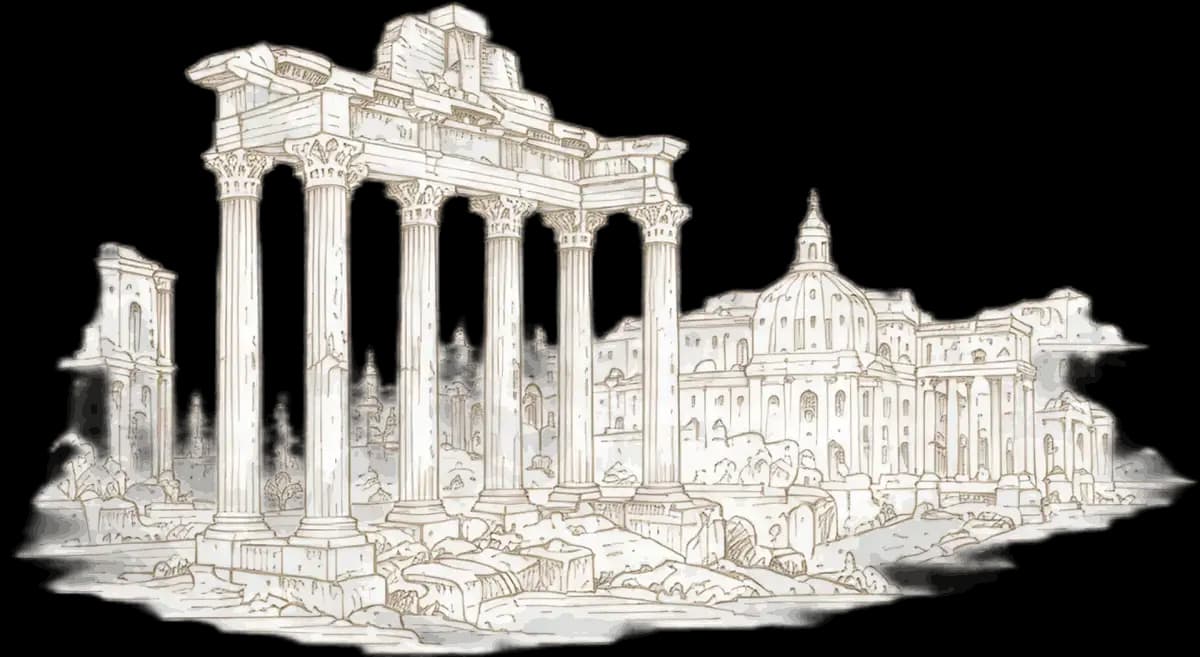
The Roman Forum is the site on the city sightseeing rome bus stops circuit where audio commentary makes the biggest difference between a comprehensible experience and a confusing one. Without context, the Forum reads as a field of disconnected column fragments and foundation courses. With the right audio guide, it becomes the most intensively occupied civic space in Western history.
The best Forum commentary delivered from the city tour bus roma on the Via dei Fori Imperiali approach does what maps and photographs cannot: it establishes the three-dimensional reality of the ancient buildings at their original height. The three surviving columns of the Temple of Castor and Pollux visible to the right were once the lower section of a complete temple facade. The brick core visible above the ground level was once faced with marble. The Forum floor you are looking at from the bus is approximately six metres above the ancient floor level, which is why the column bases are buried and only the tops are visible.
These three pieces of information, delivered in sixty seconds of GPS-triggered commentary as the bus passes the relevant section of the site, transform the visible archaeology from impressive ruin into legible ancient city.
The Vatican Approach: Commentary as Pilgrimage Preparation
The big bus tours rome commentary on the approach to the Vatican, whether live guide or prerecorded, has a specific challenge that no other section of the route presents: the audience is maximally diverse in their relationship to the subject matter. Some passengers are Catholic pilgrims for whom the Vatican is the fulfilment of a lifetime's aspiration. Some are art history enthusiasts. Some are secular tourists with no religious engagement whatsoever. Some are children who will be impressed by the size of the dome and bored by everything else.
The best Vatican approach commentary addresses this diversity by framing the site in terms that are simultaneously appropriate for all audience types. The dome's engineering, the largest masonry dome in the world after the Pantheon, is relevant to engineers, architects, and people with no religious interest. The political history of the Papal States and the Lateran Treaty that created Vatican City as an independent state in 1929 is relevant to history enthusiasts and politically curious visitors. The religious significance of the tomb of St Peter directly below the high altar is relevant to Catholic visitors in a specific and personal way.
The city sightseeing rome commentary tends to cover all three angles within the approach window, giving each segment of the passenger audience something specifically resonant before the bus arrives at the stop.
Castel Sant'Angelo: The Story Most Visitors Do Not Know
Castel Sant'Angelo is the landmark on the hop on hop off roma circuit where the best audio commentary delivers the biggest informational surprise, because the building's story is genuinely unexpected and almost none of it is visible from the outside.
The cylindrical building that most visitors photograph as a medieval fortress was originally built in the second century AD as a mausoleum for the Emperor Hadrian and his successors. The tomb chambers are inside the circular base of the building. The ashes of Roman emperors from Hadrian through to Caracalla were interred here. The later medieval conversion, first into a fortress and then into a papal refuge, was built directly over and around the ancient mausoleum in a process of architectural appropriation that the exterior does not reveal.
The Passetto di Borgo, the elevated passageway connecting the Apostolic Palace of the Vatican to Castel Sant'Angelo along the top of the old city wall, is barely visible from the bus but is one of the most operationally significant pieces of architecture in the history of the papacy. Pope Clement VII used it to escape to the fortress during the Sack of Rome in 1527 while his Swiss Guard guards were killed to the last man defending the Vatican.
None of this is visible from the bus. All of it is delivered by the commentary as the vehicle passes.
The Historic Centre: Layered History in Compact Streets
The city tour bus roma route through the historic centre between Piazza Venezia and the Vatican is the most architecturally dense section of any European hop-on hop-off circuit. Within a few hundred metres, the bus passes structures from the ancient, medieval, Renaissance, baroque, and modern periods in immediate adjacency.
The best commentary on this stretch does not try to cover everything. It selects three or four buildings where the story illuminates something broadly true about Rome's historical layering, rather than delivering a catalogue of architectural dates that no listener can retain.
A good example: the church of Sant'Andrea della Valle, whose facade is visible briefly from the city sightseeing rome bus stops circuit stretch, was the setting for the first act of Puccini's Tosca. The mention of this contemporary cultural reference, delivered as the building passes, produces an immediate click of recognition and emotional engagement that a purely architectural description of the same building would not. Good commentary uses these bridges between the historical and the contemporary to make the ancient city personally relevant to a modern listener.
How to Get the Most From the Audio System
Practical guidance for maximising the value of the city tour bus roma audio experience:
Use your own earphones. The audio quality through personal in-ear earphones is consistently better than the shared headphones provided at the seat, which are basic and sometimes have variable contact quality with the headphone socket.
Increase your phone volume if using the app. The big bus tours rome and citysightseeing apps deliver the same GPS-triggered commentary through your phone speaker or earphones. Phone volume at maximum in a moving bus environment is the starting point, not the default.
Do the full loop once without alighting. On your first circuit, stay on the bus for the complete route and use the commentary as a continuous orientation experience. You will exit with a mental map of the city's geography and history that makes every subsequent stop visit more comprehensible.
Note the sections that interest you most. The commentary will deliver information about several sites you had not specifically planned to visit. Note these as you pass and add them to your stop list for the second circuit.
FAQ
Are Fresh, Sanitized Headphones Provided Automatically Onboard Big Bus Tours Rome Vehicles?
Shared headphones are available at the individual seat headphone sockets on big bus tours rome and city sightseeing rome vehicles. Sanitization practice varies by operator and by the specific fleet maintenance schedule, but the headphones at each seat are typically replaced or cleaned between operating days rather than between individual passengers on the same day. For hygiene-conscious travellers, bringing personal in-ear earphones is always the recommended approach: they deliver better audio quality, are hygienically unquestionable, and the standard 3.5mm jack socket at each seat accommodates any standard personal earphone. The GPS-triggered commentary plays through the seat socket regardless of whether you use the provided headphone or a personal one.
Does the Audio Narration Sync Precisely as You Pass Official City Sightseeing Rome Bus Stops?
The audio narration on city sightseeing rome bus stops vehicles is GPS-triggered rather than stop-triggered, which means it fires based on the vehicle's geographic position relative to each landmark rather than at the moment of passing a specific bus stop marker. In practice, this means the narration begins at the optimal approach distance to give the listener time to look at the described building before the bus passes it. The synchronisation is generally precise under normal traffic conditions. In heavy congestion or when the bus is running significantly behind a standard schedule, the GPS position still determines the trigger point, which means the commentary aligns with the landmark's physical location rather than the time elapsed since departure.
Is the Historical Content Updated to Reflect Current Historical and Archaeological Findings?
The update frequency for city tour bus roma audio commentary content varies by operator. The major operators, including big bus tours rome and citysightseeing, conduct periodic content reviews and update the audio scripts when significant archaeological discoveries, new accessibility at sites, or revised historical interpretations warrant changes. In Rome specifically, this is relevant because active archaeological work continues in the Forum zone, the Palatine Hill, and around the Colosseum, producing findings that sometimes revise the accepted dating or function of specific structures. Commentary produced before major recent discoveries may not reflect the current state of archaeological knowledge. For the most historically current content, the live guide departures on big bus tours rome and greenline tours rome are the most reliable option, since a knowledgeable live guide incorporates new findings as they become publicly known rather than waiting for a production cycle update.
Rome Speaks Every Language. The Bus Translates.
Two thousand years of history compressed into a city the size of a large urban borough. Marble inscriptions in Latin. Greek architectural vocabulary absorbed into Roman engineering. Arabic geometric patterns in medieval church floors. Byzantine mosaics in Christian basilicas. All of it legible, all of it present, and all of it waiting to be understood by anyone who has the right guide in their ear at the right moment.
The city tour bus roma audio system is that guide. Not a substitute for deeper study, but the difference between passing Rome and reading it.
Book your hop on hop off roma or big bus tours rome pass through sightseeingroma.com. Bring your own earphones. And let the history play.
Comments (0)
At Sightseeing Roma, we believe that every traveler deserves to explore the majestic beauty and rich history of Rome with ease and comfort. Established with a passion for delivering unforgettable experiences, we are your gateway to the heart of this ancient city.
Bus Services & Tours
Stay Updated
Sign up to receive exclusive offers, travel tips, and the latest bus routes directly to your inbox.
©2026 All Rights Reserved to Sightseeing Roma