A Photographer's Masterclass: Top Vantage Points on Big Bus Tours Rome
A Photographer's Masterclass: Top Vantage Points on Big Bus Tours Rome
Summary
Most Rome travel photography is shot at street level, fighting for a clear frame against crowds, traffic, and the visual clutter of modern urban life intruding on ancient architecture. The open-top upper deck of a big bus tours rome vehicle removes all of this simultaneously. The elevation clears the crowd from your foreground. The movement gives you a continuously shifting sequence of compositions rather than a single fixed viewpoint. And the GPS-linked bigbus roma app means you know exactly when each landmark is approaching, giving you time to position yourself, adjust your settings, and be ready when the frame appears. This guide covers the five best photographic vantage points on the big bus tours rome italy circuit, the camera settings that work on a moving bus, and exactly which big bus stop to alight at if you want to go deeper on any specific composition.
Why the Big Bus Upper Deck Is a Photographer's Best Tool in Rome
Street-level Rome photography has one fundamental problem: the city was not built for cameras. The streets are narrow, the monuments are tall, and getting far enough back from any major structure to capture its full scale almost always means standing in traffic or accepting a foreground of parked scooters and tourist crowds.
The upper deck of the big bus tour bus solves the geometry problem that street photography cannot. At approximately four metres above street level, you are elevated enough to clear most of the pedestrian and vehicle clutter in the foreground while still being close enough to the architecture to maintain genuine visual connection with it. The monuments are not distant backgrounds. They are immediate, fill-frame subjects that respond to the bus's position and movement in ways that no fixed viewpoint can replicate.
The moving bus also gives you something that no photographer standing at a fixed tripod position has: a sequence. The Colosseum does not appear as a single static composition from the big bus tours rome approach along Via dei Fori Imperiali. It appears as a series of compositions that change with every ten metres of forward movement, each one slightly different in angle, in the relationship between the monument and the sky behind it, and in the quality of light falling on the western facade. Experienced travel photographers who have ridden the big bus circuit specifically for photography often describe it as a continuously changing viewfinder rather than a fixed shooting location.
Understanding Light in Rome: The Three Windows That Matter
Before the specific vantage points, the foundational rule: light is the variable that determines whether a Rome photograph works, and the big bus tours rome circuit delivers different photographic value depending on which time window you are shooting in.
The Golden Morning Window (7am to 10am)
Low-angle eastern light falls on west-facing monument facades. The Colosseum's eastern face catches direct morning light in a way that produces the deep shadows in the arched openings that give the building its most dramatic appearance. Crowd density on the circuit is at its daily low. The first big bus tour bus departure gives you the best conditions and the fullest top-deck seating choice simultaneously.
The Flat Midday Period (11am to 3pm)
Overhead light, minimal shadow, bleached sky. The monuments are visible but flat. This is when to be inside an attraction rather than on the top deck. If you are shooting during this window, switch to the lower deck for transit and save the upper deck for the hours that reward it.
The Golden Afternoon and Dusk Window (4pm to 7pm)
Low-angle western light falls on east-facing facades. The Colosseum's western arcade catches direct late afternoon sun and turns amber in the final hour before sunset. The Castel Sant'Angelo in this light, reflected in the Tiber, is the most photographically complete composition on the entire big bus tours rome italy route. This is the premium window and worth specifically planning a second circuit around if your first circuit was during the morning.
The Colosseum Approach: The Shot Every Photographer Wants
The approach to the Colosseum along Via dei Fori Imperiali from Piazza Venezia is the signature photographic sequence of the big bus tours rome circuit. No other stretch delivers a comparable combination of monument scale, foreground depth, and approaching reveal.
The composition begins approximately 400 metres from the Colosseum, when the monument first appears centred at the far end of the avenue above the road surface. At this distance, the full vertical scale of the structure is visible with context: the road receding into the middle distance, the Imperial Forum ruins on both sides creating lateral framing elements, and the Colosseum rising at the vanishing point.
As the bus advances, the composition changes continuously. The monument grows in the frame. The relationship between the Colosseum and the sky behind it shifts. The arched openings of the external arcade become individually distinct rather than a general texture. At approximately 100 metres out, the full western facade fills the forward frame from the front-row position on the upper deck.
Big bus stop position for this shot: The Colosseum big bus stop is at the base of the approach, which means if you alight here, you lose the sequential approach composition entirely. The best approach is to ride through the approach without alighting, shooting the sequence as the bus moves, and decide afterward whether to alight at the Colosseum stop for ground-level shooting or stay on for the return circuit.
Ideal camera settings: Fast shutter (1/800s minimum to freeze bus motion at telephoto), ISO 400 to 800, shoot in bursts to capture the best frame from the approach sequence.
Castel Sant'Angelo and the Tiber: The Reflection Shot
The stretch of the big bus tours rome italy circuit along the Lungotevere, the riverside road, gives you the single most composed and romantically complete architectural photograph available on the entire route: Castel Sant'Angelo reflected in the Tiber, with the Ponte Sant'Angelo bridge in the foreground and the angel statues creating depth along the bridge surface.
The right side of the big bus tour bus heading northwest along the Lungotevere is where this composition appears. Position yourself on the right side of the upper deck well before the approach to Castel Sant'Angelo. The bridge appears first, then the fortress beyond it, and then the Tiber surface comes into frame below as the bus reaches the optimal angle.
In morning light, the fortress catches eastern sun and the bridge is in partial shadow. In afternoon light, the western sun hits the bridge face-on, the fortress catches warm directional light, and the Tiber surface reflects the whole composition with the additional interest of the sky's warm tones.
Big bus stop position for this shot: The Castel Sant'Angelo big bus stop is positioned near the bridge, making it the ideal alighting point if you want ground-level access to the Tiber reflection shot from the bridge itself. From ground level, the same composition available from the bus deck can be accessed by walking onto the bridge and shooting back toward the fortress.
Ideal camera settings: Medium telephoto (50-100mm equivalent) to compress the bridge and fortress into a tighter relationship. Polarising filter if available to manage water reflection glare. Slower shutter is possible when the bus is stopped at a traffic light near this stretch.
The St Peter's Reveal Along Via della Conciliazione
The pedestrianised Via della Conciliazione, the broad avenue connecting the Tiber to St Peter's Square, was engineered by Mussolini in the 1930s to create a direct visual axis between the river and the basilica. Whatever the historical cost of the construction, the resulting composition is one of the most formally beautiful approaches to a building in any city.
The big bus tours rome route approaches Via della Conciliazione from the Lungotevere end, meaning passengers on the upper deck experience the St Peter's dome as a progressive reveal: first appearing above the roofline of the surrounding buildings, then clearing them progressively, then rising fully at the end of the avenue as the bus rounds the final corner before St Peter's Square.
In afternoon and evening light, the dome is front-lit with warm golden light on the western facade. In morning light, it is partially silhouetted, which produces a different but equally compelling backlist composition if you are specifically working in black and white or high-contrast colour.
Big bus stop position for this shot: The Vatican big bus stop delivers you to the Lungotevere adjacent to this approach. If you have already shot the approach from the bus, alighting here and walking the length of Via della Conciliazione on foot gives you the ground-level version of the same compositional sequence at a pace you control entirely.
The Forum From Above: A Shot Most Visitors Never Get
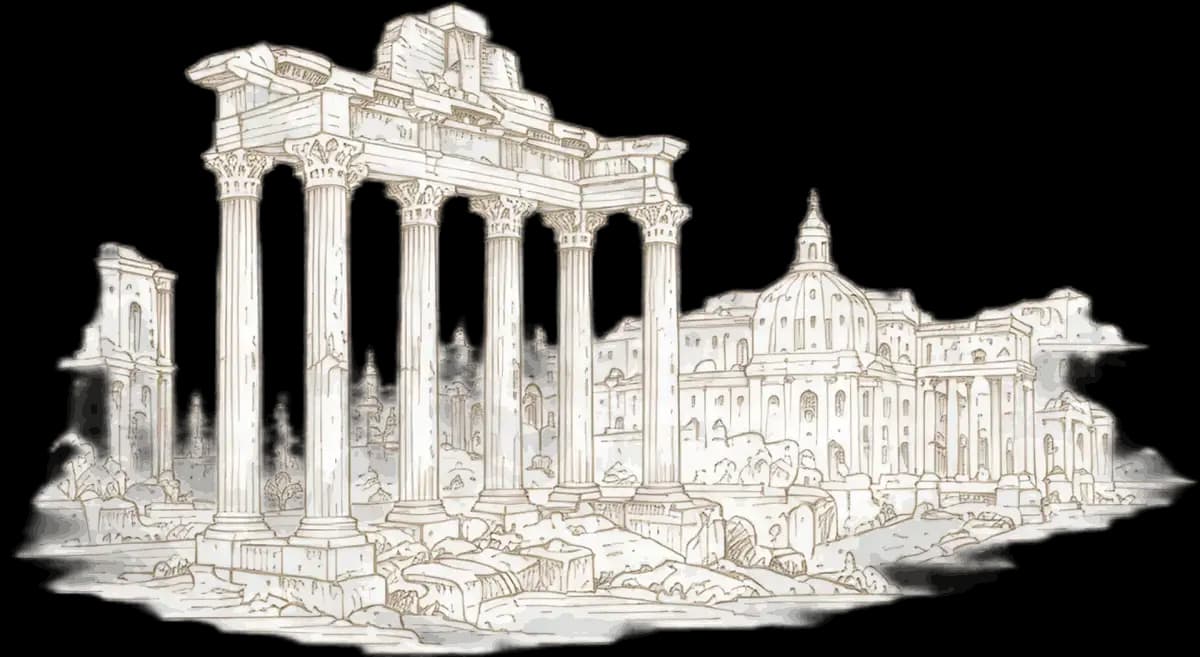
The Roman Forum, visible from the big bus tours rome route along Via dei Fori Imperiali, is one of the most frequently missed photographic opportunities on the entire circuit because most passengers are focused on the Colosseum ahead and treat the Forum as a subsidiary view.
From the upper deck, looking left as the bus travels south along the avenue, the Forum complex is visible from above at an angle that no pedestrian access within the archaeological park provides. The surviving column arrangements, the temple platforms, the Arch of Titus at the far end, and the Colosseum beyond the southeastern boundary of the site are all visible simultaneously from this elevated moving perspective.
This is a shot that requires a medium telephoto and a fast shutter to isolate specific column arrangements from the surrounding urban context. The morning light is best for this composition, as the low eastern sun falls directly on the main Forum axis.
Camera Settings for a Moving Bus
A moving bus introduces vibration and forward motion that require specific compensation to achieve sharp results.
Minimum shutter speed: 1/500s for wide-angle shots. 1/1000s or faster for telephoto focal lengths above 100mm. The bus creates low-frequency vibration that shows up in telephoto images at slower shutters even with optical image stabilisation.
Image stabilisation: Always active. Both in-camera IS (IBIS on mirrorless cameras) and lens-based IS contribute meaningfully on a moving vehicle. If your camera has both, use both.
Autofocus mode: Continuous AF tracking for approaching subjects (the Colosseum growing as the bus advances). Single AF for stationary compositions shot during brief stops.
Burst mode: Use it on approaching landmark sequences. The best frame from a 10-shot burst is reliably better than a single deliberate shot on a moving vehicle.
Exposure mode: Aperture priority with auto-ISO is the most practical setting for a full circuit, since the light changes between sun and shadow as the bus moves through narrow streets and open piazzas alternately.
Which Big Bus Stop to Alight at for Each Signature Frame
Colosseum approach sequence
Best Big Bus Stop: Ride through, do not alight
Notes: The approach is the shot; alighting ends it
Colosseum exterior ground level
Best Big Bus Stop: Colosseum stop
Notes: 2-3 min walk to the facade base
Roman Forum elevated view
Best Big Bus Stop: Ride through Via dei Fori Imperiali
Notes: Left-side upper deck, southbound
Castel Sant'Angelo reflection
Best Big Bus Stop: Castel Sant'Angelo stop
Notes: Walk to bridge for ground-level version
St Peter's dome reveal
Best Big Bus Stop: Ride through, then Vatican stop
Notes: Walk Via della Conciliazione on foot
Piazza Venezia and Vittoriano
Best Big Bus Stop: Piazza Venezia stop
Notes: Vittoriano rooftop for the elevated counter-view
Evening Colosseum floodlit
Best Big Bus Stop: Ride through on evening circuit
Notes: Stay on bus, top deck, rightside seats
The Evening Circuit: When the Light Does the Work for You
The big bus evening service, running until 8pm to 9pm depending on the season, is the most photogenically productive circuit for photographers who have already covered the standard landmarks in daylight.
At dusk and after dark, the floodlighting of Rome's major monuments creates a different set of conditions from anything available in daylight: warm amber artificial light against dark sky, monument surfaces that glow independently of the ambient light, and the specific quality of the Tiber's night reflections that require neither tripod nor long exposure from the upper deck of a moving bus.
The bigbus roma app's live tracking feature is specifically useful for evening photography planning. Knowing that your bus is seven minutes from the Castel Sant'Angelo approach gives you time to shift to the right side of the upper deck, change your settings for the reduced light conditions, and be positioned when the composition appears.
Check the Offer page at sightseeingroma.com for the current evening circuit departure schedule. Evening circuits can be booked as part of a combo with a standard daytime pass for the best combined rate.
FAQ
Which Specific Big Bus Stop Provides the Closest View of the Colosseum Walls?
The big bus stop closest to the Colosseum walls is the designated Colosseum stop on Via Sacra, positioned at the base of the monument's approach path approximately two to three minutes on foot from the exterior arcade. From this stop, the full height of the surviving travertine walls is directly visible at close range without any obstruction, making it the closest accessible ground-level vantage point on the entire big bus tours rome circuit. However, for the elevated architectural view that shows the full vertical scale of the monument in relationship to the surrounding ruins, the upper deck of the big bus tour bus during the approach along Via dei Fori Imperiali, approximately 200 to 400 metres from the stop, delivers a composition that no ground-level position near the Colosseum stop can replicate.
Are Tripods or Extension Selfie Sticks Allowed on the Upper Level of the Big Bus Tour Bus?
Standard compact tripods and small selfie sticks are generally tolerated on the open-top upper deck of the big bus tour bus during non-peak periods when space allows. Full-size tripods with wide leg spreads are not practical on the upper deck due to seating configuration and the safety concern of protruding equipment on a moving vehicle. The most practical photographic support for the upper deck environment is a mini-tripod or gorilla-pod style flexible support that can brace against the seat back or the deck railing, combined with the camera's internal image stabilisation. Extension selfie sticks used at moderate extension (not fully extended overhead) are generally fine during quiet departures but may need to be folded during busier periods if they obstruct other passengers' views.
Is the Route Map for Big Bus Tours Rome Italy Designed to Maximize Panoramic Street Views?
Yes, the big bus tours rome italy route is specifically designed around Rome's most significant visual corridors rather than simply connecting landmark to landmark by the most direct path. Via dei Fori Imperiali, the approach to the Colosseum, is the defining example: the route uses this broad avenue specifically because it provides the unobstructed forward approach to the Colosseum that narrow alternative streets would not. The Lungotevere routing along the Tiber river serves the Castel Sant'Angelo composition rather than cutting through the city centre directly. The approach to the Vatican via the riverside road positions the bus for the Via della Conciliazione reveal. Each of these routing decisions reflects a conscious choice to maximise the visual experience from the upper deck. The bigbus roma route map, available in the operator app, shows the specific road-level path of the circuit, which confirms that the longer visual corridors are prioritised over the shorter direct connections.
Every Stop Is a Composition. The Bus Connects Them All.
Rome is the most photographed city in the world for the same reasons it is the most visited: two thousand years of extraordinary architecture concentrated in a relatively compact area, lit by a Mediterranean sun that makes travertine and marble glow in ways that stone in colder cities does not.
The big bus tours rome open-top upper deck is the moving platform that gives you continuous access to this material without the ground-level compromises of crowds, traffic, and the narrow-street geometry that limits most street photography in the historic centre.
Book your big bus tours rome italy pass through sightseeingroma.com. Download the bigbus roma app and enable the live tracking. Plan your morning circuit around the early light. Plan your afternoon circuit around the golden hour. And let the bus show you the city that most Rome photographs are trying and mostly failing to capture.
The compositions are there. The bus puts you in front of them.
Comments (0)
At Sightseeing Roma, we believe that every traveler deserves to explore the majestic beauty and rich history of Rome with ease and comfort. Established with a passion for delivering unforgettable experiences, we are your gateway to the heart of this ancient city.
Bus Services & Tours
Stay Updated
Sign up to receive exclusive offers, travel tips, and the latest bus routes directly to your inbox.
©2026 All Rights Reserved to Sightseeing Roma