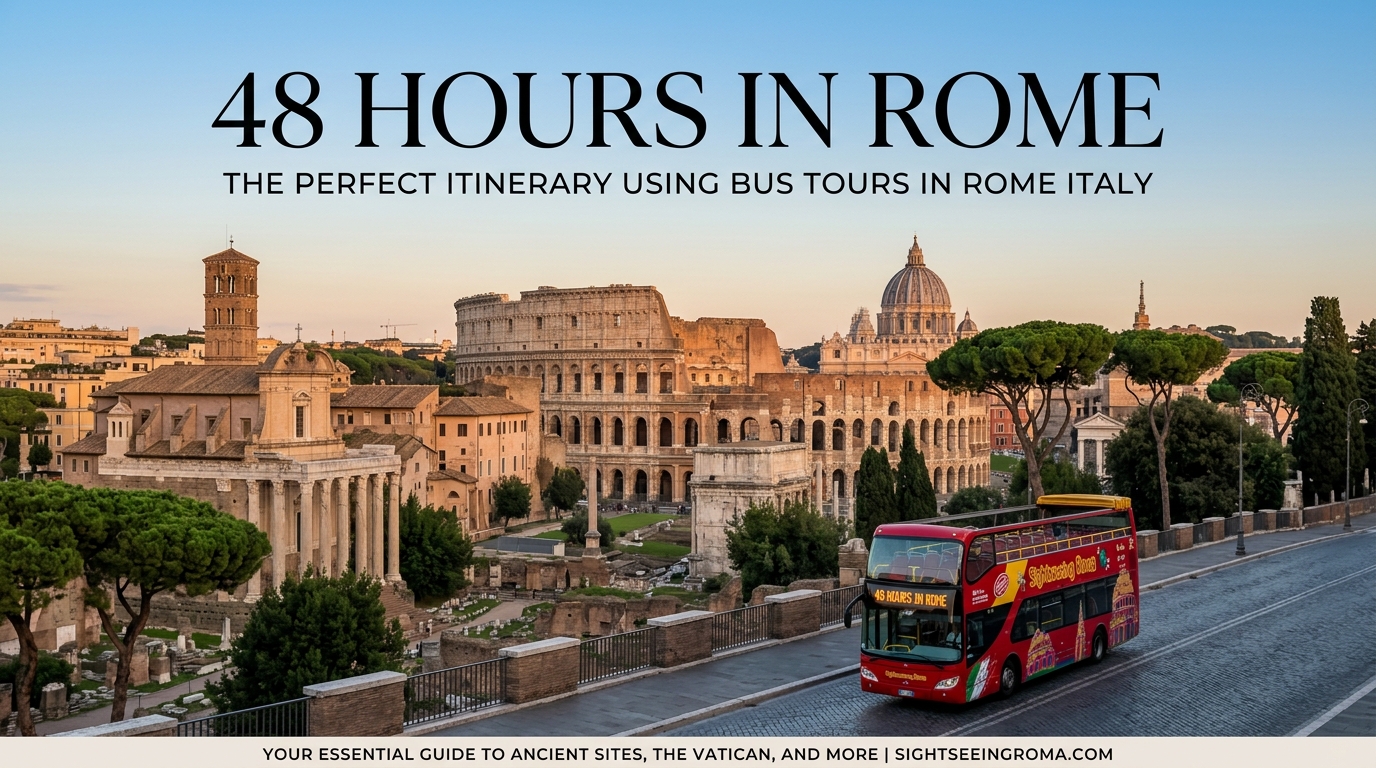
48 Hours in Rome: The Perfect Itinerary Using Bus Tours in Rome Italy
Summary
Forty-eight hours sounds like a lot until you are actually standing in Rome trying to decide between the Colosseum and the Vatican. The city is enormous, the landmarks are spread across a wide geographic area, and the gap between a rushed, exhausting two days and a genuinely satisfying one comes down almost entirely to how well you plan your transport. This guide builds a complete two-day sightseeing Rome itinerary around the bus tours in Rome Italy network, using the hop-on hop-off system as your primary way of moving between zones. You will cover the essential ancient sites on day one, shift to the Vatican and the quieter neighbourhoods on day two, and finish both evenings with enough energy left to actually enjoy dinner. Practical, strategic, and built for real travellers.
Why the Bus Should Be Your Primary Transport for 48 Hours
Rome's metro is limited. It has two main lines and neither of them stops anywhere near the Pantheon, Piazza Navona, the Trevi Fountain, or most of the sites you actually came to see. Taxis work but they add up fast over two days, particularly during peak season when traffic across the historic centre can be genuinely painful. Walking is wonderful for short distances but Rome is larger than it looks, and covering serious ground on foot in summer heat will leave you exhausted well before you have seen half of what you planned.
Bus tours in Rome Italy solve all of this in one ticket. A 48-hour hop on hop off Roma pass gives you unlimited boarding across the main route network for two full days. You move between landmark clusters efficiently, you hear commentary on what you are passing, and you conserve enough energy to actually enjoy the city rather than collapsing at your hotel by 4pm.
The strategy is simple: use bus sightseeing Rome for the long distances between zones and your feet for everything within each zone once you arrive.
Before You Start: What to Book in Advance
One of the most common mistakes first-time Rome visitors make is assuming they can sort everything on the day. They cannot. Not during spring and summer. These three things need to be booked before you travel:
Colosseum and Roman Forum entry. Timed slots sell out weeks ahead during peak season. Book online. Select your entry time for Day 1 morning.
Vatican Museums and Sistine Chapel. The same applies. Book your timed entry for Day 2 morning. Without a pre-booked slot you can expect to queue for several hours.
Your 48-hour hop on hop off Roma bus ticket. Book through sightseeingroma.com before you fly for the best available rate and confirmed availability. Buying at the stop on the day costs more and there is no guarantee of the pass type you want.
With those three things confirmed, the rest of the 48 hours falls into place around them.
Day One: Ancient Rome, the Historic Centre, and the Evening Passeggiata
8:30am: Board at Termini
Most visitors staying near the centre will find their nearest hop on and off tour Rome stop within a ten-minute walk of their hotel. Termini is the most convenient starting point for Day 1 and the most frequently served stop on the main route. Board early. Top-deck seats fill up quickly during peak season and the morning light on the way to the Colosseum is genuinely worth being up for.
9:00am to 12:00pm: Colosseum, Roman Forum, and Palatine Hill
Alight at the Colosseum stop. Your pre-booked timed entry gets you in without queuing. Allow three hours for the Colosseum, the Roman Forum directly adjacent, and the Palatine Hill, all of which are covered by the same combined ticket. The Forum is where ancient Rome actually happened politically and commercially. The Palatine Hill above it offers one of the best elevated views of the entire site. Most visitors rush through these to get to the next thing and regret it. Give this zone the time it deserves.
Practical note: wear comfortable shoes. The Roman Forum involves a lot of uneven ancient stone.
12:15pm: Reboard Toward Piazza Venezia
From the Colosseum bus sightseeing Rome stop, the next bus will get you to Piazza Venezia in around fifteen minutes depending on traffic. Stay on the top deck for the stretch along Via dei Fori Imperiali, the wide avenue that runs between the Colosseum and Piazza Venezia with the ruins of the Imperial Forums visible on both sides. This is one of the best stretches of the entire route from an elevated viewing perspective.
12:30pm to 1:30pm: Vittoriano Rooftop and Lunch
Alight at Piazza Venezia and climb the Vittoriano. The rooftop terrace offers a panoramic view of Rome that is free to access and genuinely rivals anything you will pay for in the city. From the top you can orient yourself across the entire historic centre before you descend into it.
For lunch, walk toward Campo de' Fiori or the surrounding streets. This is a more local eating zone than the immediate Piazza Venezia area and the prices reflect it. Avoid any restaurant with photographs on the menu and a host standing outside trying to wave you in.
2:00pm to 4:30pm: Pantheon, Piazza Navona, and the Historic Centre on Foot
This section of the day is best done entirely on foot. The distances are short and the streets between the Pantheon and Piazza Navona are among the most rewarding to walk in the city.
The Pantheon requires a pre-booked timed ticket. If you sorted this in advance, walk straight in and spend 30 to 40 minutes inside. The Pantheon is one of those buildings that photographs cannot fully prepare you for. The scale of the unreinforced concrete dome and the quality of light through the oculus is something you need to stand inside to understand.
From the Pantheon, Piazza Navona is a seven-minute walk north. The piazza itself is free to visit. Bernini's Fountain of the Four Rivers at the centre is worth examining closely. The surrounding streets have good gelato if you are building toward an afternoon sugar requirement.
5:00pm: Reboard Toward Trastevere or Back to Hotel
By late afternoon, most visitors have covered enough ground for one day. Reboard the hop on and off tour Rome bus from the historic centre stop and either head back to your hotel to rest before dinner, or continue to a Trastevere stop if that route is covered by your pass. Trastevere is the ideal neighbourhood for dinner: local restaurants, outdoor seating, and an atmosphere that the tourist-heavy areas around the Colosseum and Vatican simply cannot replicate.
Evening
Dinner in Trastevere or in the streets around Campo de' Fiori. After dinner, walk to the Trevi Fountain. The crowds are thinner after 9pm and the fountain lit at night is genuinely beautiful. From there, a walk back through the historic centre toward your hotel is one of Rome's great free pleasures.
Day Two: The Vatican, Castel Sant'Angelo, and the Quieter North
8:30am: Board Toward the Vatican
Day 2 starts at the Vatican. Board your city bus tours Rome Italy pass and ride to the Vatican district stop. Your pre-booked Vatican Museums entry should be for the 9am or 9:30am slot if possible, before the site fills up.
9:00am to 12:30pm: Vatican Museums, Sistine Chapel, and St. Peter's Basilica
Allow three and a half hours for the Vatican. The Museums and Sistine Chapel will take two to two and a half hours depending on how much time you spend in the galleries leading to the Sistine. St. Peter's Basilica has no entry fee and is a separate experience from the Museums. Go through the Sistine Chapel, exit into St. Peter's Square, and then enter the Basilica. Climbing to the top of the dome costs a small fee and is worth it for the view across Rome.
Practical note: the Vatican dress code is enforced. Shoulders and knees must be covered for both men and women. Scarves are available for purchase near the entrance if you forget.
12:30pm: Lunch Near Castel Sant'Angelo
Walk from St. Peter's Square along the river toward Castel Sant'Angelo. The streets in this area have a good range of lunch options without the extreme tourist pricing you find immediately adjacent to the Vatican entrance. Eat, rest, and prepare for the afternoon section.
2:00pm to 3:30pm: Castel Sant'Angelo
Castel Sant'Angelo is one of Rome's most underrated sites. The cylindrical fortress was originally built as a mausoleum for Emperor Hadrian, converted into a papal fortress in the medieval period, and used as a refuge by popes escaping threats across the city via the elevated passageway known as the Passetto di Borgo, which is still visible from outside. The rooftop terrace offers a different perspective on Rome from the Vatican rooftop you visited this morning. Queues here are consistently shorter than at the major sites, making it a more relaxed afternoon experience.
3:45pm: Reboard Toward Piazza del Popolo and Villa Borghese
Reboard the hop on and off tour Rome bus and continue north to Piazza del Popolo. The twin baroque churches at the south end of the piazza are among the most elegant in the city and almost always walkable without a queue. From here, the Villa Borghese gardens are a short walk uphill. The gardens are free to enter and offer a green, shaded alternative to the stone and concrete of the main tourist zones.
Note: if you booked a Borghese Gallery ticket in advance, this is the afternoon slot that makes most sense. The Gallery is one of the best art experiences in Rome and the ticket includes timed entry. Without a pre-booked slot, you cannot enter.
5:30pm: Final Loop Back Through the City
Board the bus sightseeing Rome circuit for one more loop before the day ends. Riding back through the historic centre in the late afternoon light, with the day's sightseeing done and no agenda left to follow, is a different experience from the purposeful morning boarding. Watch the city wind down. Watch the locals emerge. Use the time to identify anything you want to return to if you have an extra morning before your flight.
Evening
Your second and final Rome dinner should be in a neighbourhood you have not already eaten in. If Day 1 was Trastevere, make Day 2 the Prati district near the Vatican, or the streets around Piazza Navona, or the Jewish Ghetto for some of the best carciofi alla giudia you will find anywhere in the city. Rome rewards curiosity. Even the meal planning benefits from it.
What a 48-Hour Hop On Hop Off Roma Pass Realistically Covers
To manage expectations clearly, here is what two full days of city bus tours Rome Italy realistically gets you:
Day 1 coverage: Colosseum, Roman Forum, Palatine Hill, Vittoriano, Pantheon, Piazza Navona, Campo de' Fiori, Trevi Fountain, Trastevere.
Day 2 coverage: Vatican Museums, Sistine Chapel, St. Peter's Basilica, Castel Sant'Angelo, Piazza del Popolo, Villa Borghese, Prati neighbourhood.
That is the essential Rome. Not every corner of it, but the core of what most visitors come specifically to see, covered without exhaustion and with enough time at each site to actually absorb it rather than just photograph it.
FAQ
Is a 48-Hour Hop On Hop Off Roma Ticket Enough to See Everything?
Honestly, no ticket is enough to see everything in Rome. The city has more than 900 churches, thousands of years of layered history, and entire neighbourhoods that reward days of slow exploration. But a 48-hour hop on hop off Roma pass is enough to see the essential Rome that most first-time visitors come for. The Colosseum, Forum, Vatican, Pantheon, Castel Sant'Angelo, Trastevere, and the historic centre are all reachable and coverable within the two-day structure. What it will not cover is the Catacombs on the Appian Way, Tivoli, Ostia Antica, or the quieter northern neighbourhoods beyond Villa Borghese. Those require either a dedicated third day or a specific extended route booking. If you are fitting Rome into 48 hours for the first time, a 48-hour pass built around the itinerary in this guide gives you a genuinely full and satisfying experience.
What Are the Best City Bus Tours Rome Italy for Nighttime Views?
Most standard city bus tours Rome Italy hop-on hop-off services operate until early evening, typically between 7pm and 9pm depending on the operator and the season. They are not designed for nighttime sightseeing in the strict sense. However, several operators including City Sightseeing Roma and Big Bus offer special evening or sunset tours that run later into the night and are specifically routed to show Rome's illuminated monuments and piazzas. These are usually ticketed separately from the standard day pass and run on fixed departure times rather than the regular hop-on hop-off format. The Trevi Fountain, the Colosseum, St. Peter's Square, and the bridges along the Tiber are all significantly more atmospheric after dark, and an evening circuit that passes these sites is a genuinely worthwhile addition to a two-day itinerary if you have the energy for it. Check sightseeingroma.com for current evening tour availability and pricing.
Do These Bus Sightseeing Rome Tours Run on Sundays and Holidays?
Yes. Bus sightseeing Rome tours including all major hop-on hop-off operators run on Sundays and on most public holidays. Rome is a year-round tourism city and the operators structure their schedules accordingly. However, there are a few practical notes worth being aware of. On major Italian public holidays such as Ferragosto in August, Easter Sunday, and Christmas, some routes may operate on a reduced frequency schedule rather than the full peak-season timetable. Additionally, some individual attractions have modified opening hours on Sundays and holidays that may affect how you plan your stop timing. St. Peter's Basilica, for instance, has specific access restrictions on Sunday mornings during papal Mass. Checking the opening hours of each attraction you plan to visit alongside the bus sightseeing Rome schedule is always worthwhile before you finalise your day-by-day plan. sightseeingroma.com publishes current service information including any holiday schedule adjustments.
48 Hours Done Right
Rome in 48 hours is absolutely achievable. Not leisurely, not exhaustive, but deeply satisfying if you plan the transport correctly and commit to the structure rather than improvising your way through it.
The bus tours in Rome Italy network is the backbone that makes it work. It handles the distances, it delivers the context, and it gives you the flexibility to adjust on the fly without losing time to logistics. Book your 48-hour hop on hop off Roma pass through sightseeingroma.com before you travel, confirm your attraction entries in advance, and arrive in Rome ready to use every hour of your two days well.
The city will do the rest.
Comments (0)
At Sightseeing Roma, we believe that every traveler deserves to explore the majestic beauty and rich history of Rome with ease and comfort. Established with a passion for delivering unforgettable experiences, we are your gateway to the heart of this ancient city.
Bus Services & Tours
Stay Updated
Sign up to receive exclusive offers, travel tips, and the latest bus routes directly to your inbox.
©2026 All Rights Reserved to Sightseeing Roma