
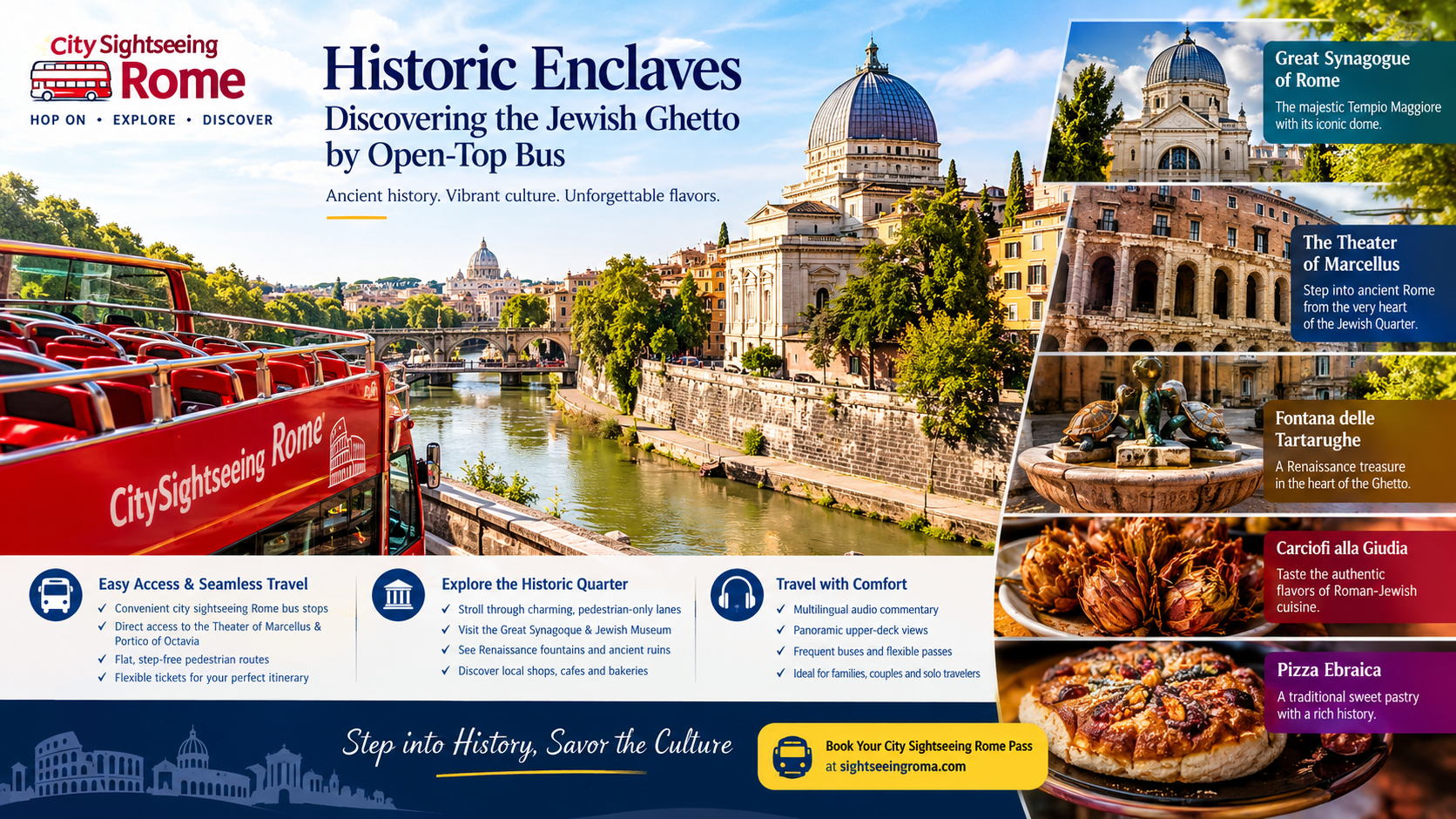
Historic Enclaves: Discovering Rome's Jewish Ghetto by Open-Top Bus
Explore centuries of Jewish heritage, ancient Roman architecture, Renaissance landmarks, and authentic culinary traditions with the convenience of an open-top sightseeing bus.
Overview
Exploring Rome's historic enclaves requires a thoughtful balance between convenient transportation and leisurely walking. The ancient Jewish Ghetto, nestled near the Tiber River, offers a fascinating journey through centuries of history, architecture, and culinary heritage.
The thoughtfully planned City Sightseeing Rome hop-on hop-off bus network provides a practical way to explore major landmarks while connecting travelers with historic neighborhoods beyond Rome's busiest streets.
With strategically located stops, panoramic upper-deck views, and flexible sightseeing opportunities, visitors can discover the Jewish Quarter, the Theater of Marcellus, and nearby Renaissance treasures without relying entirely on municipal transportation.
1. Two Millennia of Heritage: The Enduring Legacy of Rome's Jewish Quarter
Tucked along the eastern bank of the Tiber River, opposite Tiber Island, Rome's Jewish Quarter is home to one of the oldest continuously established Jewish communities in Europe.
Although the community's roots reach back to ancient Rome, the formal Jewish Ghetto was established in 1555 under Pope Paul IV, when Jewish residents were forced to live within a restricted, walled district.
Despite centuries of discrimination and hardship, the community preserved its distinctive religious traditions, cultural identity, language, and culinary heritage.
Today, the neighborhood welcomes visitors with an extraordinary combination of:
- Narrow cobblestone streets and historic ochre-colored buildings.
- Ancient Roman ruins incorporated into later architecture.
- Renaissance fountains and intimate public squares.
- Traditional Jewish-Roman restaurants and bakeries.
- Synagogues, museums, and monuments commemorating the community's history.
The neighborhood remains a living cultural and residential district, making it much more than an ordinary sightseeing destination.
2. Panoramic Perspectives: The Tiber River and the Great Synagogue
One of the most recognizable landmarks of Rome's Jewish Quarter is the magnificent Great Synagogue of Rome, also known as the Tempio Maggiore.
Completed in 1904, the synagogue stands as a powerful symbol of the community's history following the end of the papal ghetto restrictions.
Its distinctive square dome rises above the surrounding rooftops, creating a striking architectural landmark along the Tiber.
Depending on the sightseeing bus route, travelers may enjoy views of the river embankments and nearby historic monuments from the panoramic upper deck.
The surrounding area reveals Rome's extraordinary architectural layering, where ancient Roman structures coexist with medieval buildings, Renaissance palaces, and modern urban life.
Travel Tip: Check the current City Sightseeing Rome route map before departure. Bus routes and stop locations can change, and not every service travels directly along the Jewish Quarter's riverfront.
3. Strategic Disembarkation: Theater of Marcellus and Piazza Venezia
Two useful landmarks for planning a walk toward the Jewish Quarter are the Theater of Marcellus and Piazza Venezia.
Theater of Marcellus
The Theater of Marcellus is one of ancient Rome's most impressive surviving entertainment structures.
Completed under Emperor Augustus and dedicated to his nephew Marcellus, the theater was inaugurated in 13 BC. Its monumental arches and classical columns offer a remarkable introduction to Roman architecture.
From this area, visitors can continue toward the Portico of Octavia and the heart of the Jewish Quarter.
Piazza Venezia
Piazza Venezia serves as another convenient orientation point for exploring central Rome.
From the square, travelers can walk toward the Theater of Marcellus and continue into the Jewish Quarter, passing important historic landmarks along the way.
Important: Confirm which of these locations are served by your specific sightseeing bus operator. Stop names and walking distances vary by route.
4. Walking Through the Heart of the Jewish Ghetto
A walk through the Jewish Quarter offers a quieter, more intimate experience than Rome's grand avenues.
Begin near the Portico of Octavia, an ancient monumental complex reconstructed during the reign of Augustus.
The surviving columns and stone structures create a dramatic entrance to Via del Portico d'Ottavia, one of the neighborhood's principal streets.
As you explore, you will encounter traditional restaurants, historic bakeries, small squares, and commemorative plaques that reflect the neighborhood's complex history.
Much of the quarter is pedestrian-friendly, although some streets contain uneven cobblestones, narrow sidewalks, and occasional vehicle access.
For travelers with reduced mobility, choosing routes carefully and allowing additional time can make the experience more comfortable.
5. Architectural Highlights: Renaissance Fountains, Synagogues, and Roman Ruins
Fontana delle Tartarughe — The Turtle Fountain
Located in Piazza Mattei, the elegant Fontana delle Tartarughe is among Rome's most charming Renaissance fountains.
Its bronze figures, delicate turtles, and marble basin create an intimate artistic landmark that contrasts beautifully with the monumental architecture elsewhere in the city.
The Jewish Museum of Rome
Housed within the Great Synagogue complex, the Jewish Museum of Rome preserves important collections of ceremonial silver, manuscripts, historic textiles, and objects documenting Roman-Jewish life.
Visitors can gain a deeper understanding of the community's traditions, resilience, and cultural contributions through its exhibitions.
Portico of Octavia — Ancient Roman Heritage
This monumental archaeological site offers a fascinating glimpse into the city's ancient past and its transformation through successive historical periods.
Together, these attractions demonstrate the remarkable cultural diversity concentrated within a relatively small area of central Rome.
6. Culinary Traditions: Discovering Authentic Jewish-Roman Cuisine
A visit to Rome's Jewish Quarter would be incomplete without discovering its distinctive culinary traditions.
Generations of Jewish-Roman cooking have contributed beloved dishes to the city's broader gastronomic identity.
Carciofi alla Giudia — Jewish-Style Artichokes
Perhaps the neighborhood's most famous specialty, carciofi alla giudia consists of artichokes fried until their outer leaves become golden and crisp while the heart remains tender.
This iconic dish is particularly associated with Roman-Jewish cuisine.
Pizza Ebraica — Traditional Jewish Pastry
Despite its name, pizza ebraica is not a conventional savory pizza.
It is a rich, dense pastry traditionally prepared with ingredients such as almonds, raisins, pine nuts, and candied fruit.
Historic bakeries around Via del Portico d'Ottavia are excellent places to discover this local specialty.
A relaxed lunch or afternoon pastry stop adds a memorable culinary dimension to your sightseeing experience.
7. Practical Cultural Etiquette and Visiting Advice
The Jewish Quarter remains an active religious, residential, and cultural community. Respectful visiting practices help preserve its atmosphere and traditions.
- Dress appropriately: Modest clothing is advisable when visiting religious sites. Check specific entrance requirements before arriving.
- Allow time for security: Visitors to the Great Synagogue and Jewish Museum may be subject to security screening.
- Check opening schedules: Religious holidays, Shabbat, and special events may affect access to museums, synagogues, and businesses.
- Wear comfortable footwear: Historic cobblestones and uneven surfaces can make extended walking tiring.
- Plan for accessibility: Some pedestrian routes are relatively level, but not all surfaces are wheelchair-friendly.
- Verify bus services: Sightseeing bus operating hours, stops, and frequencies may vary seasonally.
8. Suggested Walking Itinerary: Discover the Jewish Quarter at Your Own Pace
For visitors who want to combine open-top bus sightseeing with an enjoyable cultural walk, the following itinerary provides a convenient starting point.
- Theater of Marcellus: Begin beside the impressive ancient Roman theater.
- Portico of Octavia: Explore the archaeological remains and historic pedestrian streets.
- Great Synagogue of Rome: Admire its distinctive architecture and cultural significance.
- Jewish Museum of Rome: Discover the history and traditions of Rome's Jewish community.
- Fontana delle Tartarughe: Finish at the elegant Renaissance Turtle Fountain.
This itinerary combines ancient architecture, cultural heritage, religious landmarks, and picturesque public spaces in one compact neighborhood.
9. Frequently Asked Questions
Which City Sightseeing Rome bus stop is best for accessing the Theater of Marcellus?
A stop near the Theater of Marcellus would provide convenient access to the monument and the nearby Jewish Quarter. Piazza Venezia is another useful starting point. However, visitors should consult the operator's current route map to confirm the nearest active stop.
Does the City Tour Bus Roma audio commentary cover the Jewish Quarter's culinary traditions?
Multilingual audio guides commonly introduce Rome's major historical and cultural landmarks. The exact coverage of the Jewish Quarter and its culinary traditions depends on the operator and commentary program.
Is the Jewish Quarter accessible to wheelchair users and visitors with strollers?
Several approaches to the neighborhood are relatively level, but historic cobblestones, uneven paving, and occasional narrow passages can present accessibility challenges. Visitors should verify suitable routes and bus accessibility arrangements in advance.
How much time should I allow to explore the Jewish Ghetto?
Allow approximately two to three hours for a relaxed neighborhood walk, architectural sightseeing, and a food stop. Visiting the Jewish Museum and Great Synagogue may require additional time.
When is the best time to visit the Jewish Quarter?
Weekday mornings and afternoons are often convenient for exploring. Sunday can also be enjoyable, although restaurant and museum schedules vary. Check opening hours and Jewish religious holiday schedules before visiting.
Explore Hidden Historic Quarters with Open-Top Ease
Rome's Jewish Ghetto is a remarkable destination where ancient ruins, Renaissance artistry, centuries of Jewish heritage, and distinctive culinary traditions come together.
Combining a leisurely neighborhood walk with an open-top sightseeing bus offers a flexible way to experience both Rome's famous monuments and its quieter historic corners.
From the monumental Theater of Marcellus to the elegant Turtle Fountain, every street reveals another chapter of the Eternal City's extraordinary past.
Make your Roman adventure more comfortable, flexible, and memorable.
Explore available routes and book your official City Sightseeing Rome passes through SightseeingRoma.com.
Discover the history. Experience the culture. Explore Rome at your own pace.